
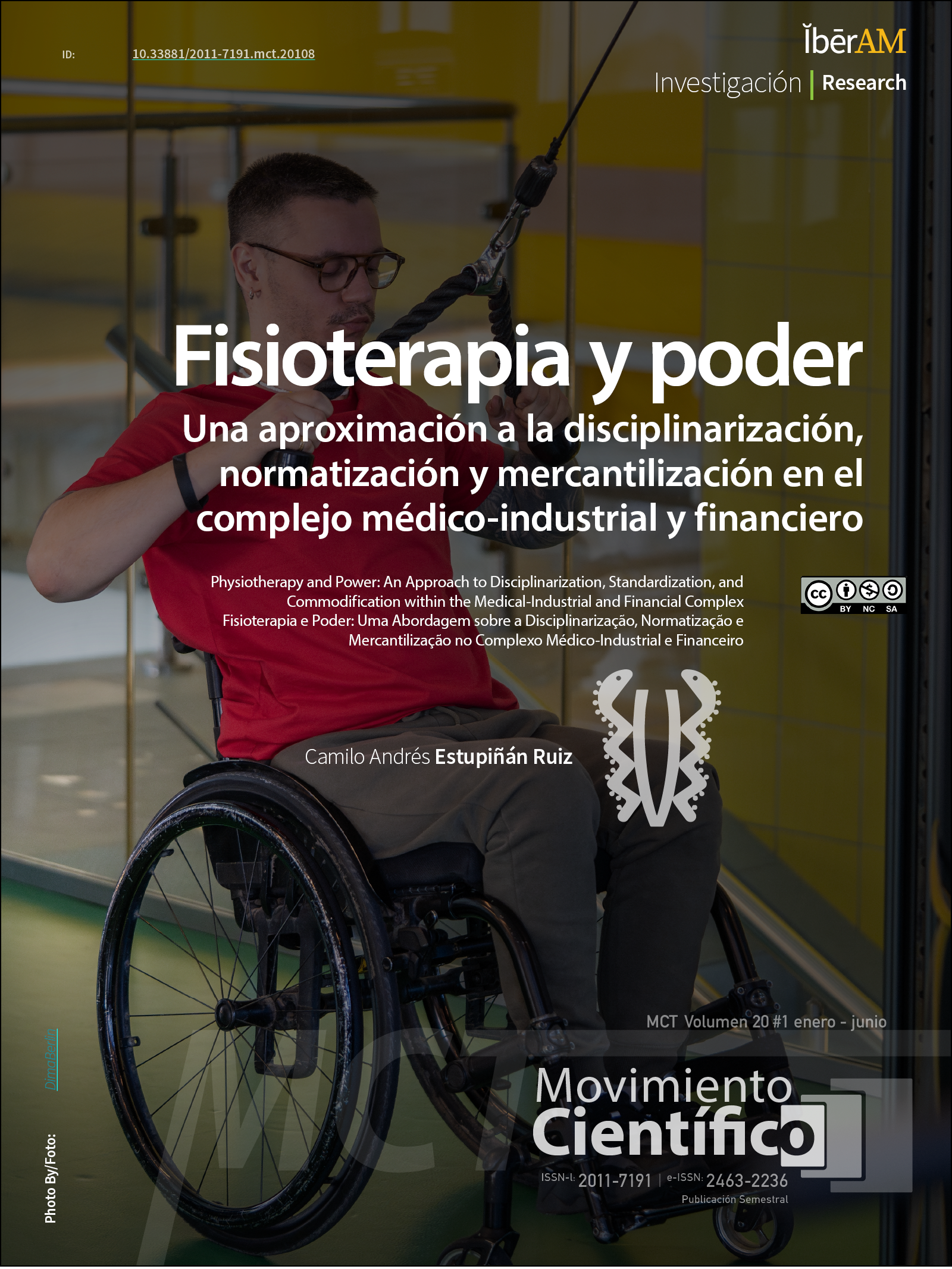
Physiotherapy and Power
Fisioterapia y Poder An Approach to Disciplinarization, Standardization, and Commodification in the Medical-Industrial-Financial Complex. narrative review of the literature.
Article Sidebar
 PDF (Español (España))
 FLIP
FLIP
 XML (Español (España))

COPYRIGHT NOTICE
The authors who publish in the Movimiento Científico Journal agree with the following terms:
1. The authors retain the copyright and guarantee the journal the right to be the first publication of the work, as well as licensed under a Creative Commons Attribution-NonCommercial-ShareAlike 4.0 International that allows others to share the work with an acknowledgment of authorship , the mixture or remix must be published under the same initial publication license, does not allow commercial exploitation of it.
2. The concepts and opinions expressed in the articles are the sole responsibility of the authors and do not commit the Ibero-American University Corporation. The contents of this magazine are distributed under license: Creative Commons Attribution-NonCommercial-ShareAlike 4.0 International.
3. The Movimiento Científico Journal is open access, so that both the editorial process and the published content are available to all users free of charge: the Magazine does not charge for reading or publishing.
Responsibilities. The concepts, opinions and ideas expressed in the published articles are the responsibility of the authors.For purposes of compliance with this point the authors must fill out the Letter of originality, which will be sent along with the article to the magazine's mail.
Citations



Main Article Content


Introduction: Physiotherapy, as a discipline and profession, has historically been configured within a network of power relations that articulate clinical practices, biomedical discourses, and economic rationalities. In this context, tensions emerge between the therapeutic function and the processes of social control, standardization, and commodification of care. Objective: To critically explore, through a narrative review of the literature, how physiotherapy has been shaped by power dynamics that insert it into processes of disciplining, standardization, and commodification within the medical-industrial and financial complex, as well as its implications for professional autonomy and person-centered care. Methods: A critical narrative review of academic literature, normative documents, and theoretical frameworks of biopolitics, power, and medicalization was conducted. The analysis focused on identifying conceptual categories and discursive patterns that highlight the interaction between physiotherapy and power structures in contemporary healthcare. Results: Four axes were identified: disciplining, expressed in the consolidation of knowledge and practices that normalize the body and the profession; standardization, materialized in guidelines, protocols, and indicators that reorient practice toward standardized efficiency; commodification, which transforms therapeutic procedures into units of productivity and profitability; and the integration of these processes into the medical-industrial-financial complex, which subordinates care to economic ends. Conclusions. Physiotherapy, far from being a neutral practice, is influenced by power dynamics that limit its autonomy and condition its practice toward productivist objectives. There is a need to critically rethink the training, practice, and social role of physiotherapists, guiding them toward an emancipatory project committed to equity and social transformation.







Downloads
Article Details
Bjorbækmo, W. S., & Engelsrud, G. H. (2011). Experiences of being tested: A critical discussion of the knowledge involved and produced in physiotherapy practice. Physiotherapy Theory and Practice, 27(6), 403–414. https://doi.org/10.3109/09593985.2010.533277
Castellanos-Vega, R. del P., & Rodríguez-Navas, Y. A. (2017). Caracterización de condiciones laborales de egresados de fisioterapia de la Universidad de Boyacá, Colombia. Revista de Investigación, Desarrollo e Innovación, 8(1), 97–106. https://doi.org/10.19053/20278306.v8.n1.2017.5560 DOI: https://doi.org/10.19053/20278306.v8.n1.2017.5560
Cevallos, J. P. (2017). Intersecciones de género, clase, etnia y raza: Un diálogo con Mara Viveros. Íconos. Revista de Ciencias Sociales, 57, 117–121. DOI: https://doi.org/10.17141/iconos.57.2017.2529
DANE. (2018). Encuesta Nacional de Calidad de Vida 2018. Discapacidad y acceso a servicios de salud. Departamento Administrativo Nacional de Estadística. https://microdatos.dane.gov.co
Eslava Castañeda, J. C., Sáenz, M., Roncancio, T., & Roncancio, M. (2015). Estado del arte sobre el Complejo Médico Industrial. Universidad Nacional de Colombia.
Espíndola, D. S. (2017). Evolução histórica da fisioterapia: da massagem ao reconhecimento profissional (1894–2010). Fisioterapia Brasil, 12(5), 389–394. https://doi.org/10.33233/fb.v12i5.944
Falquet, J. (2022). Imbricación: más allá de la interseccionalidad. Mujeres, raza y clase en los movimientos sociales. CLACSO.
Fanlo, L. G. (2011). ¿Qué es un dispositivo?: Foucault, Deleuze, Agamben. A Parte Rei. Revista de Filosofía, 1(73), 1–8. http://serbal.pntic.mec.es/AParteRei
Foucault, M. (1975). Vigilar y castigar: Nacimiento de la prisión. Siglo XXI.
Foucault, M. (1976). La voluntad de saber (Vol. 1 de Historia de la sexualidad). Gallimard.
Foucault, M. (2007). Security, territory, population: Lectures at the Collège de France, 1977–78. Palgrave Macmillan.
Gibson, B. E., Nicholls, D. A., Setchell, J., & Groven, K. S. (2020). Critical physiotherapy and the question of social justice. Physiotherapy Theory and Practice, 36(9), 972–978. https://doi.org/10.1080/09593985.2018.1557350
Guarín, L., Wilches Luna, E., Quitzel Caicedo Molina, I., Latorre Vesga, E., & Molina Achury, N. J. (2024). Caracterización del rol del fisioterapeuta en atención primaria en salud. Revista Colombiana de Rehabilitación, 23(1), 45–59.
Gutiérrez, M. (2023). ¿Imbricación e interseccionalidad? Dos términos de la estructura de opresión del sistema capitalista: Entrevista con Jules Falquet. Revista Colombiana de Sociología, 46(2), 111–128.
Mbembe, A. (2003). Necropolitics. Public Culture, 15(1), 11–40. https://doi.org/10.1215/08992363-15-1-11 DOI: https://doi.org/10.1215/08992363-15-1-11
McRuer, R. (2008). Crip theory: Cultural signs of queerness and disability. NYU Press. DOI: https://doi.org/10.1080/15017410701880122
Méndez Castillo, J. A. (2020). La rehabilitación desde la economía política crítica: Un debate necesario. Revista Gerencia y Políticas de Salud, 19(39), 1–14. https://doi.org/10.11144/Javeriana.rgps19.repc DOI: https://doi.org/10.11144/Javeriana.rgps19.repc
Méndez Castillo, J. A. (2022). Dinámicas del Complejo Médico Industrial y Financiero en la Rehabilitación Física en el Sistema General de Seguridad Social en Salud (1993–2015): El caso de las prótesis auditivas [Tesis doctoral]. Universidad Nacional de Colombia.
Mitchell, D. T. (2015). The biopolitics of disability: Neoliberalism, ablenationalism, and peripheral embodiment. University of Michigan Press. DOI: https://doi.org/10.3998/mpub.7331366
Moffat, M. (2012). A history of physical therapist education around the world. Journal of Physical Therapy Education, 26(1), 13–23. https://doi.org/10.1097/00001416-201210000-00005 DOI: https://doi.org/10.1097/00001416-201210000-00005
Nicholls, D. A. (2017). The end of physiotherapy. Routledge. DOI: https://doi.org/10.4324/9781315561868
Nicholls, D. A., & Gibson, B. E. (2010). The body and physiotherapy. Physiotherapy Theory and Practice, 26(8), 497–509. https://doi.org/10.3109/09593985.2010.481011 DOI: https://doi.org/10.3109/09593981003710316
Pagliarulo, M. A. (2016). Introduction to physical therapy. Mosby Elsevier.
Penchaszadeh, V. (2022). Bioética, salud y complejo médico-industrial-financiero: Una visión desde América Latina.
Revista Latinoamericana de Sociología, Política y Cultura, 4(2), 21–37.
Praestegaard, J., Gard, G., & Glasdam, S. (2015). Physiotherapy as a disciplinary institution in modern society: A Foucauldian perspective on physiotherapy in Danish private practice. Physiotherapy Theory and Practice, 31(1), 17–28. https://doi.org/10.3109/09593985.2014.933917 DOI: https://doi.org/10.3109/09593985.2014.933917
Sabogal, M., Samper, T., & Sensorial, D. (2013). Caracterización de la oferta laboral para fisioterapeutas en Colombia. Revista Colombiana de Rehabilitación, 12(1), 76–83. https://doi.org/10.1016/S0121-8123(13)70039-2 DOI: https://doi.org/10.30788/RevColReh.v12.n1.2013.38
Sarmiento, M., & Cruz, I. (1996). Historia de la fisioterapia en Colombia. Corporación Universitaria Iberoamericana.
Schouten, F., & Probst, A. (2024). The importance of theory and model development for building physiotherapy as a discipline in Germany. physioscience, 20(3), 116–125. https://doi.org/10.1055/a-2188-6299 DOI: https://doi.org/10.1055/a-2188-6299
Setchell, J., Nicholls, D., Gibson, B. E., & Wåhlin, C. (2018). Physiotherapy as ‘business’: Analyses of discourses within private practice. Physiotherapy Theory and Practice, 34(6), 430–439. https://doi.org/10.1080/09593985.2017.1419523
Simoni, D., & Borenstein, M. S. (2011). Evolução histórica da fisioterapia: da massagem ao reconhecimento profissional (1894–2010). Fisioterapia Brasil, 12(5), 389–395. DOI: https://doi.org/10.33233/fb.v12i5.944
Tremain, S. (2008). Foucault and the government of disability. University of Michigan Press.
Viveros-Vigoya, M. (2023). Interseccionalidad, giro decolonial y comunitario. CLACSO.
Waitzkin, H. (2017). Healthcare in the USA: Understanding the medical-industrial complex. En H. Waitzkin (Ed.), Health care under the knife: Moving beyond capitalism for our health (pp. 107–117). Monthly Review Press.
World Confederation of Physical Therapy. (2019). Descripción de la fisioterapia. Declaración de política. https://world.physio
Banco Mundial. (2022). Gasto en salud (% del PIB) – Colombia. https://data.worldbank.org/indicator/SH.XPD.CHEX.GD.ZS?locations=CO







